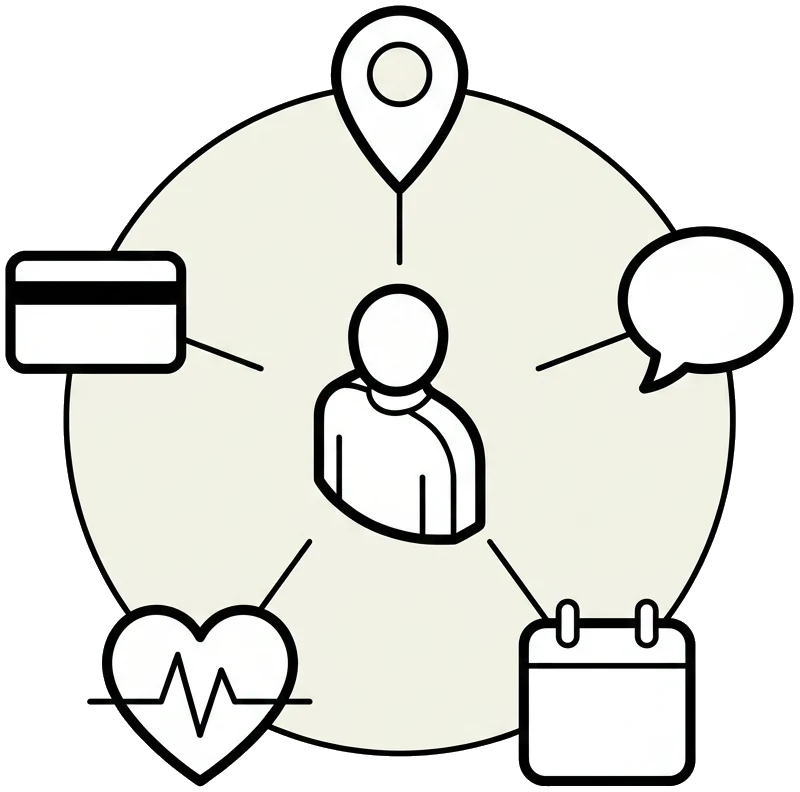




The world does revolve around you.

One brain. All the hats.

The best-run people in the world have a Chief of Staff. Someone who briefs them before every meeting, remembers who everyone is, takes the notes (in the Zoom call and at the coffee), drafts the follow-up, and quietly holds the whole week together. Ostler is a Chief of Staff that runs on your Mac. It wears every hat a real one would – across your digital life and your real one – and it costs less per month than a Notion subscription.

The short version

You are probably paying for eight, ten, twelve different apps that each do one small slice of what one good assistant would do for you. Ostler is that one good assistant. One brain that has your context, your history, and your relationships all in one place, and can therefore act as chat, note-taker, personal CRM, email triager, research assistant, and everything else at once. All for roughly the cost of a single Notion seat.
The Chief of Staff analogy

A real Chief of Staff does not say “sorry, that’s Notion’s job” when you ask them what you agreed with Pierre last week. They do not say “that lives in Superhuman” when you ask what your inbox needs today. They do not say “I’d have to check Otter for the transcript” when you ask what was decided in Tuesday’s call. They just know. Because it is all in the same head.

That is what a personal AI has to be to be worth having. Not fifteen small clever tools sharing your data with fifteen different cloud companies. One system that carries your whole context and wears whichever hat the moment calls for.

Most people cannot afford to hire a Chief of Staff. The ones who can quickly find that a good one commands a six-figure salary, needs onboarding and holidays, and has to be trusted with the most private parts of your life. Ostler skips all of that. It never goes on leave. It never leaves the room. And every piece of context it holds sits on your Mac, encrypted, private to you.

The hats it wears

Every one of these is a category with its own subscription, its own login, its own privacy policy. Ostler covers all twelve from a single install on your Mac.

General AI chat

Ask it anything, but from a model that knows your history, your people, and your projects.

Instead ofChatGPT · Claude · Gemini · Perplexity

In-person conversations

Ostler captures the coffee, the dinner, the walking meeting. What you promised at brunch is remembered the same way as what you agreed in a Zoom call.

Instead ofPlaud · Rewind · Limitless · Bee

Digital meeting notes

Automatic capture and summary of your Zoom, Teams, and Meet calls. Action items and who-said-what, all transcribed on your Mac. No bot joining the call.

Instead ofGranola · Otter · Fireflies · Fathom

Personal CRM

Every person you know, deduplicated, enriched, and linked to every conversation you have ever had with them.

Instead ofClay · Dex · Monaru · Folk

Email triage

An assistant that reads your inbox, tells you what actually needs a reply, and drafts it in your voice.

Instead ofSuperhuman · Shortwave · SaneBox

Notes and personal wiki

A living wiki of your own life that compiles itself from every conversation you have, no manual tagging required.

Instead ofNotion · Obsidian · Roam · mem

Personal AI cloud

An assistant that knows your life and belongs to you, running on your own Mac instead of somebody else’s data centre.

Instead ofKin · Poke · Jo · Rewind

Research assistant

Ask, and it searches your own history first, the public web second, and cites both.

Instead ofPerplexity · Consensus · You.com

Writing help

Drafting, tightening, and tone-matching, from a model that already knows how you sound.

Instead ofGrammarly · Notion AI · Lex

Calendar awareness

Pre-meeting briefs, prep for the person you are about to see, and evening wrap-ups of the day.

Instead ofMotion · Reclaim · Cal.com AI

Tasks and follow-ups

Action items extracted automatically from what you say or write, not typed into yet another list app.

Instead ofTodoist · Things · Any.do

Reminders that matter

Birthdays, anniversaries, and the promises you made three months ago that you have already forgotten.

Instead ofNudge · Reminders apps · sticky notes

Stitched together: the PA you can finally afford

Triage, prep, drafting, follow-up, morning brief, evening wrap. Everything a private PA does, done by one system that already has your context. All twelve hats above, worn by the same head, so nothing gets lost between them.

Instead ofHuman PA · virtual assistant services · the twelve tools above

The meter is off

Here is the part cloud AI subscriptions do not quite tell you. The better the assistant is, the more you want to talk to it. The more you talk to it, the more it costs. Every good question is metered. Every long conversation is billed. Every large document you paste in costs money to think about. You develop a little internal accountant that pipes up every time you open the chat window: is this question worth two cents? Is this one worth three? And so you use it less than you would like to. You ration.

Enterprises are already exiting this trap. Jake Saper at Emergence Capital (early backers of Salesforce, Veeva and Zoom) calls it the tokenmaxxing hangover: cloud-AI bills quietly quintuple, and the company routes the work to cheaper local models when the invoice lands. Open-weight models already carry a quarter to half the volume across major aggregator platforms and are used by roughly 80% of startups. The excuse to run everything in the cloud is thinning fast.

Ostler does not have that accountant. Your Mac’s compute is already paid for – you bought the chip, and the chip does the work. The model runs on your chip. The answers happen on your chip. There is no per-token bill, no monthly reset, no context window you are paying to keep full, no premium tier that unlocks the good model. Throw everything at it. The cost does not move.

That is the difference between an assistant you use freely and one you ration.

The maths

A modern founder or operator who takes their work seriously is probably running most of this stack today. Not all of it, but seven or eight of them, quietly billed to a card every month.

What you probably already pay forMonthly
ChatGPT Plus$20
Granola (or Fathom, or Fireflies)$14
AI recorder / pendant (Plaud, Limitless)$15
Notion + Notion AI$18
Superhuman$30
Clay (or Dex)$20
Perplexity Pro$20
Grammarly Premium$12
Personal AI (Kin, Poke, etc.)$15
Typical monthly total$164
Ostler Pro (Hub $99 once, then this)$9.99

Approximate July 2026 base prices – before per-token overages, upgraded model tiers or heavy-use surcharges kick in. Actual monthly bills usually run higher. Half this stack still pays for Ostler ten times over.

Every one of those SaaS lines is a separate cloud company holding a slice of your data. A separate login. A separate privacy policy. A separate breach notification email waiting to arrive in a year or two. Consolidating them into one system on your own Mac is not just cheaper. It is saner.

Nobody hires twelve assistants. They hire one, and expect her to remember everything.

The real magic: it all just works

Cheaper is nice. But the reason to consolidate is not price. It is the thing that happens when every hat sits on the same head.

01

No integrations to wire up

You do not spend a Sunday afternoon plugging Zapier between Granola and Notion and Clay. Meetings, notes, contacts, calendar, and email are already in the same brain the moment you install.

02

The right context arrives without asking

Ostler knows you are about to see Pierre on Thursday, so it pulls up what you last discussed, the email he sent Monday, and the promise you made in April. Twelve separate apps cannot do that. One system, watching one calendar, holding one memory, does it for free.

03

Nothing gets lost between apps

The follow-up your meeting notes tool captured makes it onto your to-do list, into the person’s CRM entry, and into the reminder that pops up next month. Because it is not being handed between three products, it just is a fact your assistant knows.

04

One trust boundary, not twelve

Every SaaS you add is a company you have to trust to not lose your data, not train on your data, not sell your data, and not go bankrupt. With Ostler there is one boundary, and it is the front door of your own Mac.

05

One bill, one place to update, one thing to keep

No annual re-shopping for the meeting notes tool because a new one launched. No cancellation flow to hunt down when a subscription creeps up. One product that improves over time and keeps everything you have ever poured into it.

The real cost

The cost of a scattered stack is not the $149 a month. It is the fact that none of those twelve tools knows what any of the others know. Which means the intelligence they add up to is much less than the sum of their parts. Ostler is the opposite bet: one brain that gets smarter about your life every day, and stays yours.

Get Ostler – $99 Why you need this ›

Related reading

Ostler vs Granola · a longer look at one of these hats. Security · how twelve trust boundaries collapse to one.

One brain. All the hats.

Private  ·  Local  ·  Yours